
The Role of Public Finance to Address the Global Finance Gap for Drinking Water Services
Kristina Nilsson (2025)
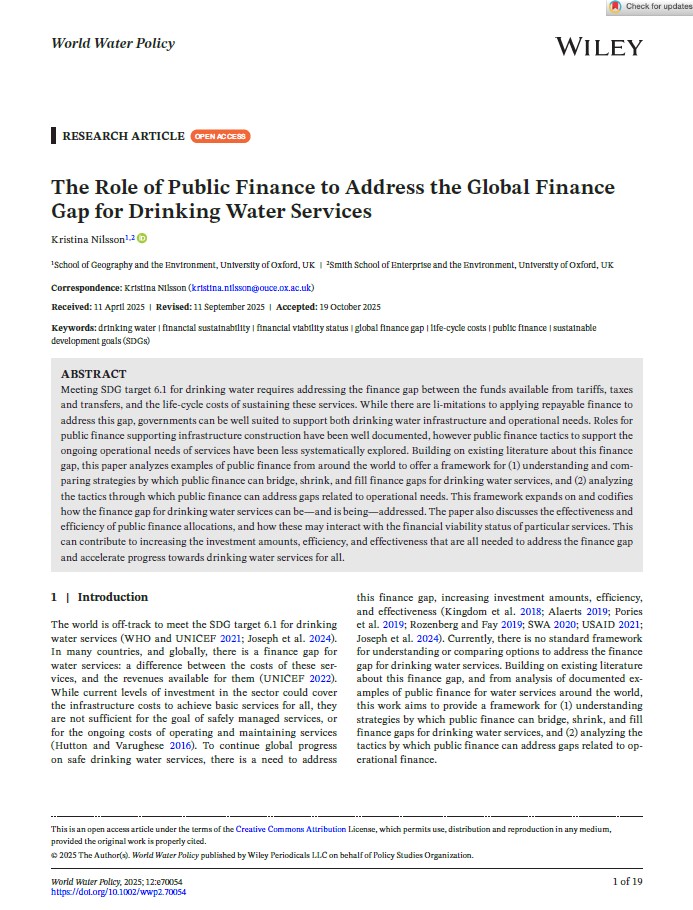
Meeting SDG target 6.1 for drinking water requires addressing the finance gap between the funds available from tariffs, taxes and transfers, and the life-cycle costs of sustaining these services. While there are limitations to applying repayable finance to address this gap, governments can be well suited to support both drinking water infrastructure and operational needs. Roles for public finance supporting infrastructure construction have been well documented, however public finance tactics to support the ongoing operational needs of services have been less systematically explored. Building on existing literature about this finance gap, this paper analyzes examples of public finance from around the world to offer a framework for (1) understanding and comparing strategies by which public finance can bridge, shrink, and fill finance gaps for drinking water services, and (2) analyzing the tactics through which public finance can address gaps related to operational needs. This framework expands on and codifies how the finance gap for drinking water services can be-and is being-addressed. The paper also discusses the effectiveness and efficiency of public finance allocations, and how these may interact with the financial viability status of particular services. This can contribute to increasing the investment amounts, efficiency, and effectiveness that are all needed to address the finance gap and accelerate progress towards drinking water services for all.
Summary
- Drinking water services globally face a mismatch between the available revenues from tariffs, taxes, and transfers, and the life-cycle costs of these services: this constitutes the global finance gap for drinking water services. The gap includes funds needed for infrastructure construction, and for ongoing operations and maintenance of services, with operational needs becoming the larger component.
- Different strategies are needed to address different components of the global finance gap for drinking water services: gap bridging strategies can help address infrastructure needs, and gap shrinking and/or filling strategies can help address operational needs. The financial viability status of services may affect which strategies are most efficient.
- Many drinking water services lack adequate tariff revenue to support ongoing operating costs. Around the world, a range of tactics are available and used by governments to shrink and/or fill this finance gap, applying policy, technical assistance, and financial instruments, at a range of cost levels. Governments should assess which tactical investments can most efficiently and effectively address the finance gaps they face and accelerate progress towards drinking water services for all.