

Intermittent Contamination of Small Water Supplies: Implications for Effective Monitoring and JMP
Raphaela Betz, Saskia Nowicki, Edith Darin, Jamie Bartram, & Katrina J. Charles (2026)
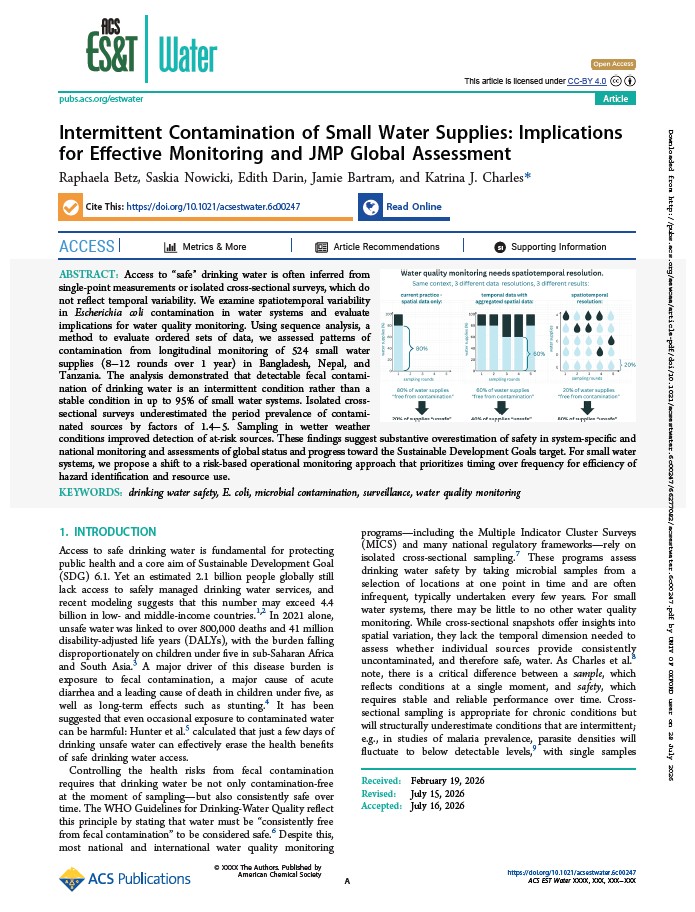
Access to “safe” drinking water is often inferred from single-point measurements or isolated cross-sectional surveys, which do not reflect temporal variability. We examinespatiotemporal variability in Escherichia coli contamination in water systems and evaluate implications for water quality monitoring. Using sequence analysis, a method to evaluate ordered sets of data, we assessed patterns of contamination from longitudinal monitoring of 524 small water supplies (8−12 rounds over 1 year) in Bangladesh, Nepal, and Tanzania. The analysis demonstrated that detectable fecal contamination of drinking water is an intermittent condition rather than a stable condition in up to 95% of small water systems. Isolated crosssectional surveys underestimated the period prevalence of contaminated sources by factors of 1.4−5. Sampling in wetter weather conditions improved detection of at-risk sources. These findings suggest substantive overestimation of safety in system-specific and national monitoring and assessments of global status and progress toward the Sustainable Development Goals target. For small water systems, we propose a shift to a risk-based operational monitoring approach that prioritizes timing over frequency for efficiency of hazard identification and resource use.